
Leveraging Students’ Achievement and Attitude towards Science through the Integrating of Inquiry-based Learning and Gamification
DOI:
https://doi.org/10.61227/ey22j996Keywords:
attitude, gamification, inquiry-based learning, pedagogy, science educationAbstract
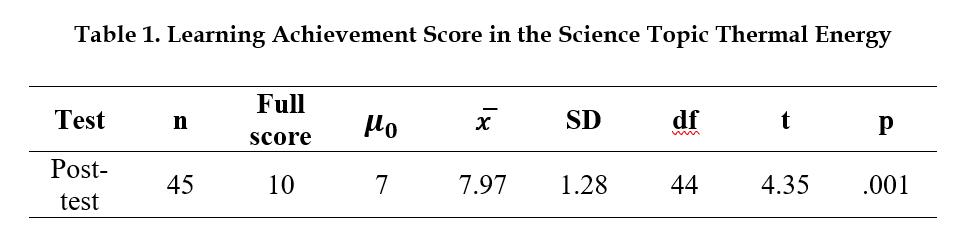
This study examines the inquiry-based learning and gamification effect on the science learning achievement and attitude towards the subject of science. Participants were 45 students enrolled in the second semester, 2025 academic year of secondary school at Roi Et Wittayalai School, Roi Et province, Thailand. The instructional intervention included organized inquiry activities with game features like points, badges, and challenges to student engagement based on constructivist learning theory and motivated learning. Students were placed into experimental research by one-group pretest and posttest design, a standardized science achievement exam was given, and attitude towards science was measured after the intervention. Statistics showed that students had considerably greater post-test scores, higher than the criterion of 70%. The results suggest that inquiry-based learning and gamification can enhance students' understanding and performance in science. Students have a positive attitude towards the subject of science with a high. The negative score was at low level. This study shows that these pedagogical methods might make lower secondary science instruction more engaging and effective for school science.
Downloads
References
Adeoye, M. A. (2025). Shaping the future: Interdisciplinary insights into human progress and tomorrow's world. FALASIFA: Jurnal Studi Keislaman, 16(01), 81-88. https://doi.org/10.62097/falasifa. v16i01.2181
Ajlouni, A., Wahba, F. A. A., Naccache, H., AlOmary, A., & Ibrahim, A. (2025). The impact of gamification-assisted instruction on the acquisition of scientific concepts and attitudes towards science class among elementary school students. European Journal of Educational Research, 14(2), 485-500. https://doi.org/10.12973/eu-jer.14.2.485
Bantaokul, P., & Polyiem, T. (2022). The use of integrated 5Es of inquiring-based learning and gamification to improve grade 8 student science learning achievement. Journal of Educational Issues, 8(1), 459-469. https://doi.org/10.5296/jei.v8i1.19802
Bhatia, M., & Mushtaq, M. T. (Eds.). (2024). Navigating innovative technologies and intelligent systems in modern education. IGI Global.
da Silva Júnior, J. N., Silveira Jucá, R. C., Melo Leite Junior, A. J., Zampieri, D., Uchoa, D. E. D. A., & Magalhães, J. S. (2025). Gamifying an organic chemistry laboratory course as a strategy to improve students’ motivation. Journal of Chemical Education, 102(8), 3355-3365. https://doi.org/10.1021/acs. jchemed.5c00139
Duanphol, N., Nuangchalerm, P., & Safkolam, R. (2024). Implementing inquiry-based science learning on the topic world and its changing of grade 8 students. Journal of Education and Teacher Training Innovation, 2(2), 172-179. https://doi.org/10.61227/jetti.v2i2.141
Erickson, M. (2016). Science, culture and society: Understanding science in the 21st century. John Wiley & Sons.
Fajeriadi, H., Irhasyuarna, Y., Yulianti, Y. E., & Kusasi, M. (2024). The effect of using inquiry model on science process skills and student learning outcomes. Jurnal Penelitian Pendidikan IPA, 10(12), 10426-10433. https://doi.org/10.29303/jppipa.v10i12.8658
Goi, C. L. (Ed.). (2024). Teaching and learning for a sustainable future: innovative strategies and best practices: Innovative strategies and best practices. IGI Global.
Jones, M., Blanton, J. E., & Williams, R. E. (2023). Science to practice: Does gamification enhance intrinsic motivation?. Active Learning in Higher Education, 24(3), 273-289. https://doi.org/10.1177/ 14697874211066882
Khonkla, J., Thumsiriwat, J., Supakesorn, B., Polyiem, T., & Prasertsang, P. (2024). Learning outcomes of an integrated inquiry-based and problem-based learnings for grade 8 science students. Journal of Green Learning, 4(1), 23-32. https://doi.org/10.53889/jgl.v4i1.366
Kunisch, S., Denyer, D., Bartunek, J. M., Menz, M., & Cardinal, L. B. (2023). Review research as scientific inquiry. Organizational Research Methods, 26(1), 3-45. https://doi.org/10.1177/10944 281221127292
Marawar, A. A., & Chaudhari, A. D. B. (2024). The future of learning: Innovations In education. Academic Guru Publishing House.
Othman, M. K., & Ching, S. K. (2024). Gamifying science education: How board games enhances engagement, motivate and develop social interaction, and learning. Education and Information Technologies, 29(18), 24525-24561. https://doi.org/10.1007/ s10639-024-12818-5
Papadakis, S., Zourmpakis, A. I., & Kalogiannakis, M. (2022). Analyzing the impact of a gamification approach on primary students’ motivation and learning in science education. In International Conference on Interactive Collaborative Learning (pp. 701-711). Cham: Springer International Publishing.
Phimthong, T., Nuangchalerm, P., Thumsiriwat, J., Dostál, J., & Wongtiankul, W. (2024). Experimental science skills of 9th-Grade students through Inquiry-Based Learning. Journal of Philology and Educational Sciences, 3(2), 14-22. https://doi.org/10.53898/ jpes2024322
Polanyi, M. (2024). Science, faith and society: A searching examination of the meaning and nautre of scientific inquiry. University of Chicago Press.
Ponil, P., & Dokmai, P. (2025). Enhancing scientific argumentation skills in chemistry on the topic of chemical bonding through argument-driven inquiry of grade-10 students. International Journal of Science Education and Teaching, 4(2), 77-92. https://doi.org/10.14456/ ijset.2025.06
Safkolam, R., Madahae, S., & Saleah, P. (2024). The effects of inquiry-based learning activities to understand the nature of science of science student teachers. International Journal of Instruction, 17(1), 479-496.
Saputra, A., Hijriyah, U., Romlah, L. S., Susanti, A., & Shabira, Q. (2025). Trends and developments in gamification for science education: A bibliometric review from 2019 to 2023. Jurnal Penelitian Pendidikan IPA, 11(1), 30-44. https://doi.org/10.29303/ jppipa.v11i1.10169
Sawyer, R. K., & Henriksen, D. (2024). Explaining creativity: The science of human innovation. Oxford university press.
Sulianta, F. (2024). Philosophy of science. Feri Sulianta.
Wangkamhan, Y., Nachaisin, K., & Kenthoraphak, P. (2024). The impact of technology on learning outcomes in Thai secondary schools: An educational psychology perspective. Journal of Buddhist Education and Research (JBER), 10(3), 184-195. https://so06.tci-thaijo.org/index.php/jber/article/view/ 282496
Zhang, F., Brynildsrud, H., Papavlasopoulou, S., Sharma, K., & Giannakos, M. (2025). Where inquiry-based science learning meets gamification: a design case of experiverse. Behaviour & Information Technology, 44(5), 1099-1121. https://doi.org/10.1080/0144929X. 2024.2433058
Zourmpakis, A. I., Kalogiannakis, M., & Papadakis, S. (2023). Adaptive gamification in science education: An analysis of the impact of implementation and adapted game elements on students’ motivation. Computers, 12(7), 143. https://doi.org/10.3390/ computers12070143
Additional Files
Published
Issue
Section
License
Copyright (c) 2026 authors

This work is licensed under a Creative Commons Attribution 4.0 International License.
How to Cite


