
Assessing Implementation of Teacher Code of Conduct in Enhancing Teachers’ Professionalism in Mkuranga District, Tanzania
DOI:
https://doi.org/10.61227/1vyfx583Keywords:
Teachers’ Code of Conduct, Professional Ethics, Policy ImplementationAbstract
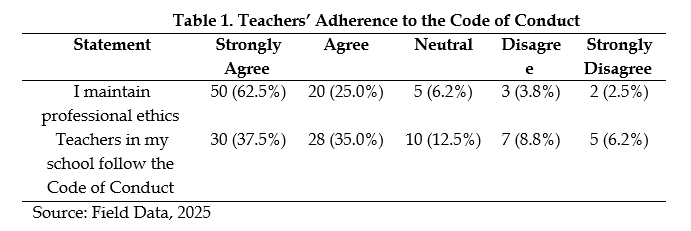
This study investigated the implementation of the Teacher Code of Conduct in public primary schools in Mkuranga District, Tanzania, addressing the critical gap between policy and practice. Despite a robust national framework and high teacher awareness, professional misconduct persists due to weak enforcement mechanisms. Employing a sequential mixed-methods design, the study collected qualitative data through interviews and focus group discussions with educators and parents, which informed a subsequent quantitative survey of teachers. Findings revealed a strong theoretical commitment to professional ethics among teachers (87.5% agreement), but qualitative evidence exposed inconsistent application, often attributed to a lack of ongoing training, mentorship, and safe reporting channels. The study concludes that awareness alone is insufficient without structured reinforcement. Grounded in Social Learning Theory, it recommends institutionalizing mandatory refresher training, case-based mentorship, and integrating code adherence into performance appraisals to foster a culture where ethical standards are consistently modeled, reinforced, and internalized.
Downloads
References
Adediran, O. (2022). Challenges of adherence to teacher codes of conduct in Nigeria. Journal of African Education, 23(1), 45-60.
Ali, S. (2022). Perceptions and impact of the teacher code of conduct in Pakistan: A qualitative inquiry. International Journal of Educational Development, 45, 102-115.
Bandura, A. (1977). Social learning theory. Prentice Hall.
Bandura, A. (1986). Social foundations of thought and action: A social cognitive theory. Prentice-Hall.
Bandura, A. (2004). Observational learning. In J. H. Byrne (Ed.), Learning and memory (2nd ed., pp. 482-484). Macmillan Reference USA.
Beijaard, D., Meijer, P. C., & Verloop, N. (2022). Reconsidering research on teachers' professional identity. Teaching and Teacher Education, 20(2), 107-128.
Bergström, P. (2021). Professional identity and the teacher code of conduct in Sweden. Scandinavian Journal of Educational Research, 65(3), 455-470.
Bush, T. (2011). Theories of educational leadership and management (4th ed.). SAGE Publications.
Chen, L. (2021). Effectiveness of teacher codes of conduct on ethical behavior in China. Asia Pacific Journal of Education, 41(4), 567-581.
Darling-Hammond, L. (2006). Constructing 21st-century teacher education. Journal of Teacher Education, 57(3), 300-314.
Education and Training Policy. (2014). Ministry of Education, Science and Technology, United Republic of Tanzania.
Education International. (2021). Professional teaching standards. https://www.ei-ie.org
Fullan, M. (2001). The new meaning of educational change (3rd ed.). Teachers College Press.
Goldhaber, D., & Grout, C. (2021). Teacher misconduct: A review of the literature and policy implications. National Center for Analysis of Longitudinal Data in Education Research (CALDER).
Gordon, M. (2021). Adherence to teacher codes of conduct and student outcomes: A longitudinal study. Journal of Educational Research, 114(5), 389-402.
Hargreaves, A., & Fullan, M. (2012). Professional capital: Transforming teaching in every school. Teachers College Press.
Hoy, W. K., & Miskel, C. G. (2013). Educational administration: Theory, research, and practice (9th ed.). McGraw-Hill.
Kibanda, G. (2021). Influence of the teacher code of conduct on ethical behavior among educators in Tanzania. Tanzania Journal of Education, 19(2), 78-94.
Kowalski, M., & Schmidt, H. (2020). A comparative analysis of teacher behavior and professional standards in Europe. European Journal of Teacher Education, 43(2), 245-262.
Lugazo, P., & Msuya, O. (2021). District-level challenges in implementing national education policies in Tanzania. African Educational Review, 18(1-2), 112-128.
Mhando, E. (2020). Adherence to teacher codes of conduct in Kenya: Successes and failures. East African Journal of Educational Research, 4(1), 34-49.
Miller, J. (2020). Barriers to teacher compliance with professional codes of conduct. Teaching and Teacher Education, 92, 103-120.
Miller, P. H. (2011). Theories of developmental psychology (5th ed.). Worth Publishers.
Mischel, W. (1999). Introduction to personality (6th ed.). Harcourt Brace.
Mkumbo, K., & Magesa, M. (2022). Monitoring and evaluation of teacher professionalism in Tanzanian primary schools. Journal of Education and Practice, 13(8), 55-67.
Mkuranga District Education Office. (2023). Annual education report. Mkuranga District Council.
Msuya, J. (2020). Implementation of the teacher code of conduct in Tanzanian primary schools. International Journal of Learning and Development, 10(3), 1-15.
Mugisha, G. (2021). Critical analysis of the effectiveness of teacher codes of conduct in Ugandan schools. Uganda Journal of Education, 14(1), 22-40.
Müller, F. (2022). Teacher codes of conduct and accountability in Germany: A systematic review. German Journal of Educational Research, 15(2), 89-104.
Nakanjako, S., & Mugisha, G. (2021). Capacity-building and ethical challenges in Ugandan teacher education. Journal of Education in Developing Areas, 29(2), 133-147.
Ng'wandu, P. (2022). Challenges of adhering to the code of conduct among teachers in Tanzania. Educational Perspectives Tanzania, 7(1), 10-25.
Nkansah, M. (2021). Implementation of teacher codes of conduct and professional ethics in Ghana. Ghana Journal of Education, 12, 67-82.
Nsengiyumva, P., & Uwitonze, J. (2022). Ethics training in teacher education: The Rwandan experience and rural challenges. Journal of Education in Africa, 5(2), 88-102.
OECD. (2021). Teachers as learning professionals: Understanding and enhancing teacher professionalism. OECD Publishing.
Ormrod, J. E. (2011). Human learning (6th ed.). Pearson.
Plomin, R., DeFries, J. C., Knopik, V. S., & Neiderhiser, J. M. (2016). Top 10 replicated findings from behavioral genetics. Perspectives on Psychological Science, 11(1), 3-23.
Schunk, D. H. (2012). Learning theories: An educational perspective (6th ed.). Pearson.
Shapiro, J. P. (2020). Ethical dilemmas and ambiguities in teacher codes of conduct. Journal of Moral Education, 49(3), 281-296.
Skinner, B. F. (1953). Science and human behavior. Macmillan.
Suleiman, A. (2022). Adherence to teacher code of conduct and teacher performance in Tanzania: A mixed-methods study. Educational Management Administration & Leadership, 50(1), 156-174.
Tanzania Teachers’ Service Commission. (2015). Code of ethics and conduct for teachers. United Republic of Tanzania.
Tanzania Teachers’ Service Commission. (2019). Teachers’ professional standards and code of conduct. United Republic of Tanzania.
Tchombang, R. (2020). Adherence to professional standards among teachers in Cameroon. Cameroon Review of Education, 8(2), 45-60.
UNESCO. (2020). Global framework of professional teaching standards. United Nations Educational, Scientific and Cultural Organization.
Waweru, J., & Kamau, R. (2022). Teacher ethics and supervision in remote areas of Kenya. Kenyan Journal of Educational Administration, 11(1), 77-89.
Yamamoto, T. (2020). Cultural expectations and challenges in adhering to teacher codes of conduct in Japan. Journal of Japanese Educational Research, 48(2), 123-138.
Additional Files
Published
Issue
Section
License
Copyright (c) 2026 authors

This work is licensed under a Creative Commons Attribution 4.0 International License.


